Hull & Decking
Wood for the hulls was of Scots pine and Corsican pine bought direct from the Forestry Commission firstly in North Wales then the Lake District and finally Nottinghamshire. Specifically asked for was wood from trees that grew in valleys as they grew quicker and meant the wood was of a lighter density, ideal for floating in water. Later hulls over 14" and the racing yachts were made from Obeche (Wawa) wood from Ghana which had the properties of a light density along with fewer knots. Some of the very small yachts, like SY/00s, can be found made from Obeche wood, these were made out of waste off cuts. Hollow hulls on the smaller Endeavour series yachts had two buoyancy compartments machined out using a circular cutter with the hull being held in a brace against it and the larger racing hulls were hollowed out using a pillar drill with a Forstner bit using a depth preset so that there was about 7/16" of hull thickness left.
Keels on the larger racing yachts were made of wood with a profiled lead ballast weight fitted at the bottom and fixed to the hull by steel countersunk screws each with a thick steel washer. The screws were made by Nettlefolds, two 12 x 2/12" or three 12 x 3" for the largest yachts.
On the early hand made hollow yachts, the deck was matched to the hull and both parts had a corresponding number written on in pencil, see photo below.

Decking on the hollow yachts was made from 1/8" thick Finnish birch plywood, picked for its pale colour and good graining pattern. Smaller yachts decks were straight forward shaped, glued and pinned on, the larger racing yachts had a central camber brace to give the deck a curved profile and a strengthener plate pinned underneath the deck to help fix the mast mounts of brass ring or cylinder type, see photo of a mast strengthener plate on an Arctic Star below.

After fitting all the deck edges were routed and sanded to give a rounded profile. Pins were countersunk and filled over. Deck plank lining was applied with a sharp pointed pencil, first a perimeter line was scribed in from the edge and then the fore to aft lines were scribed using the pencil along the edge of a rule, about every 5/16 - 3/8", smaller yachts like the Endeavours I & II could sometimes have narrower lining but the larger and racing yachts were spaced at 3/8", later production saw a template used to help space the decking lines, before coating with an oil based golden yacht varnish made by Valspar, then the deck furniture was fitted after which the deck badge or transfer logo was applied. On some of the larger racing yachts, the plank lines were radiused to follow the deck edge with a 1/2" central "King plank", see 2nd photo below.

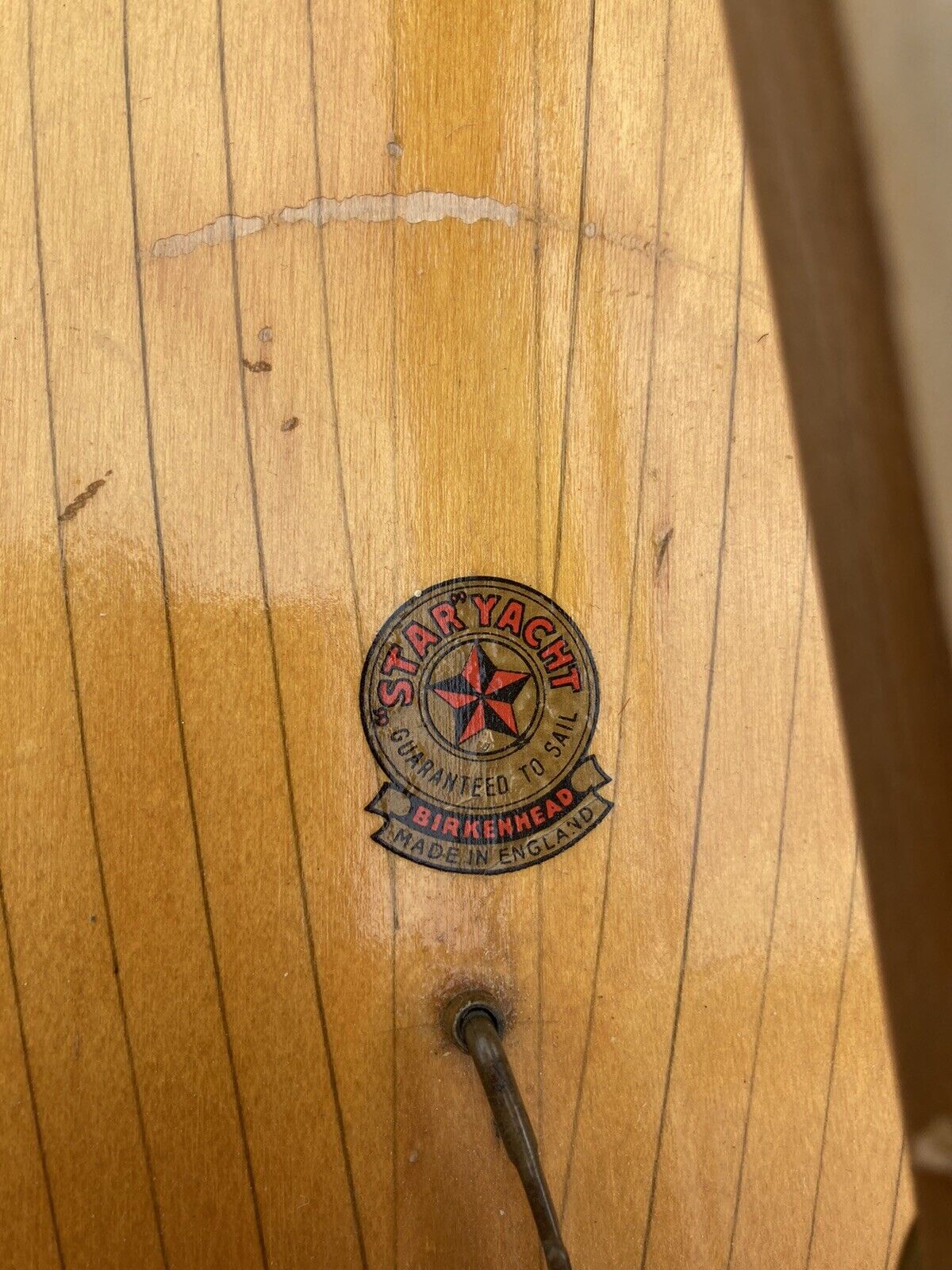
The record for fitting deck furniture, staples and mast mounts, stands at 24 dozen (288) in a day! Over a working day at the time, that works out roughly as one yacht every two minutes.
The rubbing strips on the side of some of the larger yachts, "D" shaped, were made from 1/4" birch dowel which was very carefully cut in half by an extremely thin band saw, they were pinned to the hull with short panel pins. Early examples were pained red, later ones were coloured gold or later again to match the colour theme of the yachts, red, blue, orange etc..